What does Gen Z think about AI?
The University of Cincinnati’s NEXT Innovation Scholars shared optimism and caution about AI


Gen Z is entering an AI-powered workforce with both eyes open.
They are embracing the technology’s potential while questioning what it could cost in human ingenuity, critical thinking and the value of work itself.
That mix of excitement and optimism emerged through a presentation by the University of Cincinnati’s NEXT Innovation Scholars, a select group of undergraduates who explore emerging trends and their real-world implications from their base at the school’s 1819 Innovation Hub. During StartupCincy Week in early October, the students offered a glimpse into how the next generation is thinking about AI and its future implications.
Here’s what they said.
One of AI’s greatest benefits is boosting efficiency by streamlining lengthy planning, development and execution of complex projects and processes. In doing so, according to UC’s NEXT Innovation Scholars, it also eliminates some of the hard work humans can learn and grow from.
“Previously, you would Google search something and you would find an article … It would lead you down a rabbit hole,” said NIS researcher Arya Garg. “And then from that rabbit hole, you had the potential to discover something you didn’t even know you needed to Google search. That friction enables discovery and a modality AI agents automate away.”

Garg argued that the ease of AI search versus traditional search engines could negatively affect Gen Z. Photo/UC Marketing + Communications
According to Garg, that long and sometimes frustrating discovery process helps keep people sharp, especially members of Gen Alpha and Gen Z who are still developing their skills. Getting answers delivered with almost zero effort can be beneficial in the moment, but over time it could dull a person’s ability to learn and collaborate.
The NEXT Innovation Scholars have seen growing resistance to overusing AI for this very reason. “Gen Z is realizing, ‘Hey, there’s certain types of friction we want to preserve,’” Garg notes. “And as Gen Z, we’re realizing some parts of that reduced friction are necessary to learning.”
Gen Zers recognize AI’s potential while identifying humans as irreplaceable in many areas of work and everyday life. According to NIS foresight researcher Sarah Nazzal, the future may draw a clearer division between tasks that can be automated and those to keep in human hands.
“There are some things that should be reserved for humans and some things that are just easier to get through AI,” she said. “[Humans] have the edge of … decision-making, making judgments, having that context and making a decision with it. And of course, the creativity that comes with being a human.”
[AI] is novel, but we still want to keep the human touch.
Joe Kuncheria Foresight researcher, NEXT Innovation Scholars
Building on Nazzal’s thoughts, fellow NIS researcher Joe Kuncheria said members of Gen Z often feel disappointed when polished AI-generated language replaces the personal touches they grew up with. For a generation that values authenticity, the novelty of AI can wear off quickly.
“For some of us who are younger, [AI] is novel, but we still want to keep the human touch,” he said. “We always try to add the human spice to it.”
AI is convenient, but Gen Z’s focus on originality and genuineness clashes with the seemingly perfect yet impossibly dull responses AI so often gives. Kuncheria suggested that human-AI collaboration could be the answer: “Brainstorm your way with AI, then you come up with a solution together.”
Large language models like ChatGPT and Google Gemini have become everyday tools for much of Gen Z. The next frontier is physical AI, where artificial intelligence moves beyond the screen and into the real world.
Robotics offers a glimpse of where physical AI is headed, though according to Garg, the future may look different from what many people imagine. “In the future, we’re probably going to see a lot of not humanoid-like robots, but task-specific robots that are designed to do specific things,” he said. “They’re not all going to look the same … They’re probably not going to look very human, either.”
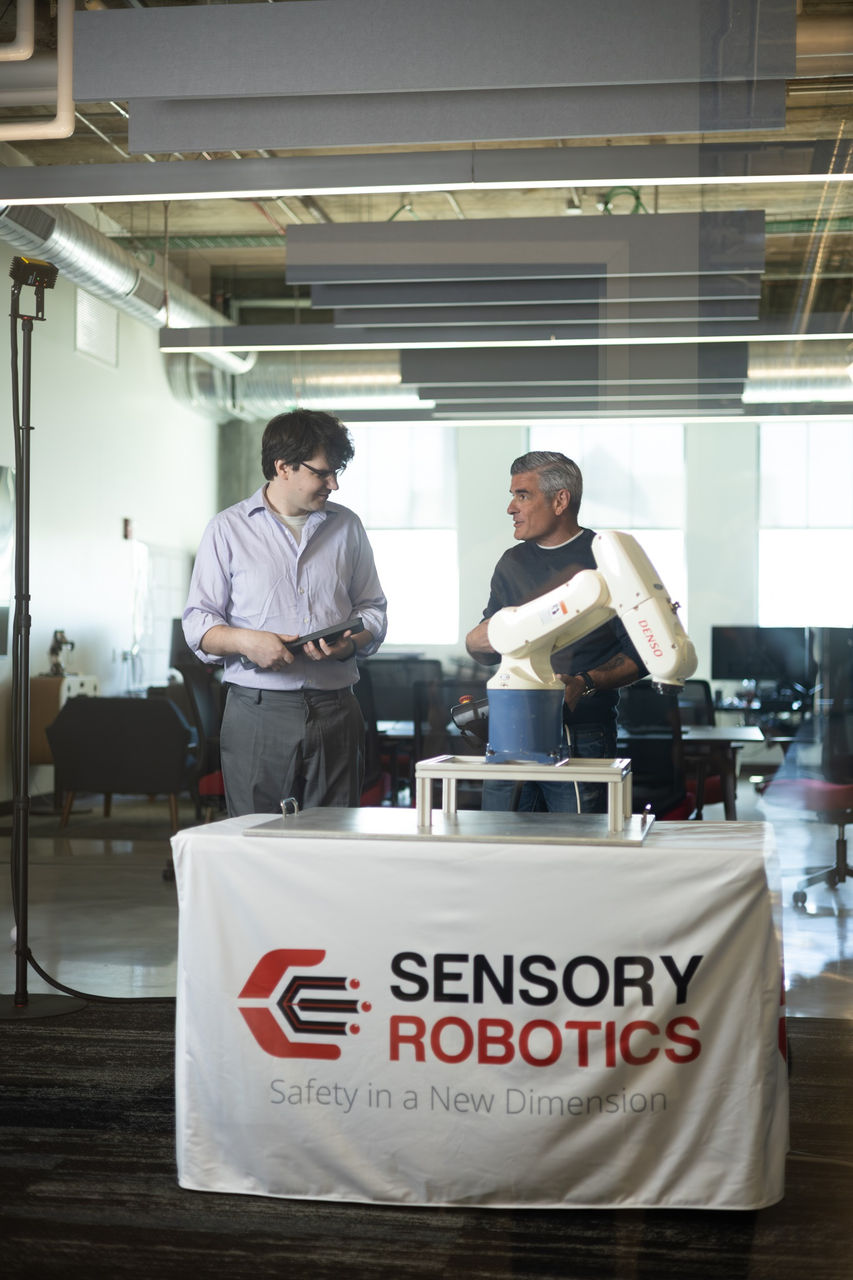
Sensory Robotics has a workspace in UC's 1819 Innovation Hub. Photo/Mary Dwyer
Human-robot collaboration is already becoming more common on factory floors. Companies like Sensory Robotics, based at UC’s 1819 Innovation Hub, and KineticArc, a member of the 1819 Venture Lab, are working to advance robotics safety and adaptability, respectively.
Garg, a student at the UC College of Engineering and Applied Science, expects the physical AI industry to grow. As he put it, “If it can be conceived, it will be done.” Across the street from 1819, in another section of the Cincinnati Innovation District, the UC Digital Futures building houses multiple labs advancing the future of robotics today.
So, what might everyday physical AI look like as Gen Z begins to age? According to the NEXT Innovation Scholars, it could include household robots that pick up your kids’ toys, wash and dry your dishes or fold your clothes.
Whether automating these tasks improves our lives depends on how much we value convenience alongside the everyday experiences we might lose. Once again, it comes down to friction. “I’m looking at it deeper here,” Garg noted. “As parents, don’t you want to interact with your kids and their messy toys, and clean them up?”
The consensus among Gen Z is that artificial intelligence will be a core part of the future. According to the NIS members, whether it plays a positive or negative role will depend in part on the guardrails put in place to guide its development and use.
Garg summed up Gen Z’s cautiously optimistic view: “I don’t agree with the way [AI] is being automated,” he said, “but I love the future potential and the implications it has for development and humanity in general.”
Many in the generation see promise in AI’s powerful ability to drive innovation and solve pressing issues. That power also creates opportunities for misuse, which is one reason young people view policies as essential to keeping AI moving in a positive direction.
Policy is evolving at a faster rate than we've seen before ... but I don't think it's evolving as fast as AI is growing.
Arya Garg Foresight researcher, NEXT Innovation Scholars
There has been some progress on AI regulation, Garg said, though he believes the pace needs to pick up. “Policy is evolving at a faster rate than we’ve seen before, so that’s a positive sign,” he said, “but I don’t think it’s evolving as fast as AI is growing.”
Meanwhile, Garg suggested that users establish their own guardrails as they explore AI. He shared two of his own tactics: building a private data silo that AI tools can’t access without permission and instructing AI to converse only in third person rather than using first-person terms such as “I,” “me” or “us.”
Nazzal agreed that AI’s rise could benefit humanity, while emphasizing the importance of keeping pace with its development. “If we are able to catch up to the level it’s developing at, and we have a plan for the future,” she predicted, “I think it would be very beneficial for the development of humanity. But on the other side, if we aren’t able to get ahead and have that planned out, there could be consequences.”
Next-gen foresight, from the next leaders
StartupCincy Week attendees filled the room to hear the NIS students’ panel session, eager to learn new perspectives on how thoughtful, tech-savvy Gen Zers view AI. Comprised of some of UC’s most promising undergraduates, NEXT Innovation Scholars is recognized by business leaders as a valuable source of foresight on emerging trends and innovation.
The views shared by Garg, Kuncheria and Nazzal reflect more than intellectual curiosity about AI. They draw on research and firsthand experience from a generation that has grown up with the technology and explored both its benefits and limitations.
The overall NIS program is structured around four pillars:

NIS students on a corporate strategy trip to London. Photo/Charlie Harker
- Insights and strategy: Actionable, human-centered insights that inform front-end innovation decisions and long-term strategy.
- Ideation: Divergent and convergent explorations of existing, proposed or speculative concepts and solutions.
- Foresight Lab: Research-driven analysis of macrotrends, leading indicators of change and the implications of multiple possible futures.
- Innovation training: Interactive workshops, trainings and experiences that unlock innovation potential and empower new approaches.
NIS students spend their time in the program conducting deep research into today’s indicators of change and how they could shape tomorrow’s world. The work is demanding and rewarding. As one of the nation’s only undergraduate foresight programs, NIS gives students the opportunity to contribute to the long-term strategies of leading companies worldwide before they graduate.
During StartupCincy Week, the students brought that future-focused knowledge back to the Cincinnati community. As AI becomes an increasingly central part of everyday life, the panel offered a chance to hear from a generation that has grown up alongside the technology and spent time studying its effects.
Frequently asked questions
Gen Z has mixed thoughts about AI, with young people enjoying its convenience but worrying about how it could reshape their careers. They largely express curiosity about AI and enjoy using it but believe it could dull their skills if overused.
Gen Z harbors complicated feelings on AI, as the group has largely adopted the tool while also believing it could devalue their skill set and dull their knowledge. In general, Gen Z likes AI's convenience while remaining split on whether the technology will ultimately serve as a net positive or negative.
Gen Z typically uses AI to enhance its productivity and learning. It often turns to AI for work- or education-related tasks like summarizing emails or readings and automating repetitive assignments. Gen Z is far more hesitant about using AI for shopping recommendations and personal advice, though adoption in these realms has started to increase.
Gen Z, along with millennials, are the most likely generation to use AI. A full 76% of Gen Z reports having used AI tools such as ChatGPT or Claude, per a 2025 report by Deloitte. Read more here for insights on how every generation uses AI.
Featured image at top: Attendees filled the room for StartupCincy Week's NIS panel. Photo/Stephen Kenney